Showing posts with label A Pioneer Ancestor. Show all posts

Monday, July 28, 2014

Edward Trimble (1815-1901) and Elizabeth Lennox (1816-1896)

Biography of Edward and Elizabeth Lennox Trimble, by Laura Morgan Trimble
Edward Trimble

EDWARD TRIMBLE, son of Robison and Mary Jefferson Trimble was born April 2, 1815, in Eastwoodside, Cumberland, Eng.  Edward learned the tailor's trade and earned his living by working in a tailor shop.

When he was twenty-four years old, he met and married ELIZABETH LENNOX, daughter of William and Elizabeth Sanderson Lennox.  Elizabeth was born May 9, 1816, in Aikton, Cumberland, England, making her twenty three years old when she married Edward Trimble, August 24, 1839.

Elizabeth and Edward had been married sixteen years when they joined the Church of Jesus Christ of Latter Day Saints.  Edward was so filled with love for this new religion that he often preached on the street corners, and being quick tempered and a boxer, he sometimes had street fights, and since Edward enjoyed boxing, the fights made preaching very exciting for Edward.

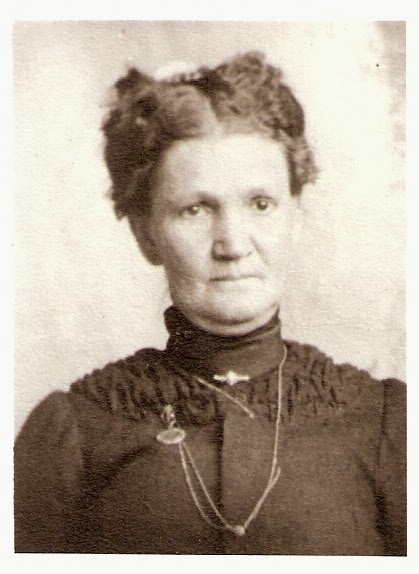
Elizabeth Lennox
Elizabeth was an excellent dressmaker and helped supply food for the family by doing sewing for her customers.  Both Edward and Elizabeth worked diligently at their trade during the daytime but when evening came they relaxed and enjoyed visiting with members of their family.  Edward played the violin and his Uncles, Aunts, Cousins, relatives living in near villages gathered at his home and danced and sang to the accompaniment of the violin.  Edward loved to jig dance, and this talent was passed down through the generations, even his grand daughters loved to do a jig dance.

The family saved their money, and on April 29, 1865 set sail for America, on a sailing vessel named the "Belle Wood".  The Trimble family consisted of: Edward, wife Elizabeth, three sons, John, Jefferson, and Joseph; two daughters, Susan and Mary Elizabeth; together with Edward's brother, John Trimble; eight people in all, members of the Trimble Family.  They were six weeks on the ocean and when they landed in New York, the Civil War was just over and they had to travel to Florence, Nebraska in dirty cattle cars.

Edward's son, John, was offered $50.00 a month if he would drive a freight wagon belonging to Kimball and Lawrence Freight Co.  John arrived in Salt Lake a month before his family did, but he was never paid for his work.  This bitter experience taught John a lesson in trusting his fellow men.  The rest of the family arrived in Utah in October, 1865, six months after leaving England, and not without deep sorrow.  While in Nebraska, Mary Elizabeth, the nine years old daughter of Edward and Elizabeth, died of black smallpox, and was buried in the Pioneer Cemetery.

Upon arriving in Salt Lake they were assigned to go to Fillmore, Utah.  Their first home was a dug out, however Elizabeth kept the home neat and tidy.  Her tin ware was always polished and shone brightly for everyone to see.  Later when they built them a brick home, Elizabeth took delight in keeping one of the cleanest, most orderly homes in Fillmore.  Elizabeth was a gracious hostess and every one was made welcome to her home.  Guests sang, danced and played games but Elizabeth never allowed gossip or slander of any type to take place in the Edward Trimble home.

Elizabeth Trimble died March 8, 1896, and Edward Trimble died April 25, 1901, both are buried in the Fillmore Cemetery.

They buried four children before reaching maturity:  Mary, born November 24, 1839, died at age 1 1/2 years; William, born June 19, 1842, died at age 3 years; Robison, born April 8, 1849, died at age 2 years; Mary Elizabeth, born Oct 28, 1856, died at age 9 years.  The first three children are buried in England, while Mary Elizabeth is buried in Nebraska.

The Children of Edward and Elizabeth Trimble who lived to maturity were:  Mary, born Nov. 24, 1839; William, born June 19, 1842; John, born May 39, 1846, married Emma Locke; Robison, born April 8, 1849; Jefferson, born October 22, 1851, married Margaret Fortie; Joseph, born May 5, 1854, married Melissa Davies.

Mary, William and Robison died as young children.
--------------------
EDWARD TRIMBLE AND ELIZABETH LENNOX TRIMBLE
by Laura Morgan Trimble

Edward Trimble - born 2 April 1815 in Eastwoodside, Cumberland, England.  The son of Robison Trimble and Mary Jefferson Trimble.

Elizabeth Lennox - born 9 May 1816 in Aikton, Cumberland, England.  The daughter of William Lennox and Elizabeth Sanderson Lennox.

At Thursby, Cumberland, England, in a modest little home surrounded by beautiful lawns and gardens, both front and back, Edward Trimble and his wife, Elizabeth Lennox made a haven of love for themselves and the eight children born to them.  Edward was tailor by trade and Elizabeth was a dressmaker.  Their daughter, Susan, often remarked, "Me father was tailor and me mother a dressmaker and they made me proud."
   
In the year 1855, Edward and Elizabeth joined the Mormon Church.  They were baptized the 19th of September.  Close to 10 years lapsed between their joining the church and their coming to America and eventually to Utah to be with the saints.  During these years Edward would spend some of his evenings preaching on the street corners.  He loved this new gospel and wanted to tell others about it.  Being a quick-tempered person -  he sometimes got too excited with the rebuffs he got from the people in his audience.

One story is told of him as he was preaching and he quoted, "And unto him that smiteth thee on the one cheek offer also the other."  This quote is from Luke 6:29.  A man listening stepped up in front of Edward and struck him on his cheek.  The quick temper of Edward flared and very quickly he struck the fellow back and said, "Begock, it didn't say that you can't  hit back."
   
Edward was also a boxer of some degree and he enjoyed this pastime very much.  I'm sure the fellow in the audience who received the slap from Edward knew he had been hit.
   
Edward spent his days in making a living for his family but many of the evenings and holidays were spent in enjoying his family and other relatives.  His uncles, aunts and cousins lived in near by townships so visiting was a regular part of their lives.  Edward played the violin and family members sang and danced to his music. (His violin is in the State House in Fillmore, Utah.)  Susan, his daughter, remarked that many times she would often hold her long skirts up and do a jig to her fathers music.  Uncle Edward Trimble, a grandson of this Edward, was noted to do a jig dance on occasions.  Could have been this jig dance was passed from grandfather to father, to son.
 
Joseph Trimble, an older brother of Edward, kept an Inn in Carlisle, England, a small town near Thursby. This Joseph was often visited by Edward and his family. They enjoyed the entertainment furnished by girls hired to sing and dance for the patrons of the Inn.
   
Edward and his wife, Elizabeth, three sons, John, Jefferson and Joseph, two daughters, Susan and Mary Elizabeth and a brother of Edward's John Trimble, left England the 29th of April in 1865.  Their mode of travel was a small sailing vessel named "Belle Wood."  This vessel had no engines for power and so movement across the ocean was accomplished by the wind blowing the boat.  Many times there wasn't enough wind to even move the boat and the vessel would float around for hours or stay still for days.  When the wind came again, the course would again be charted and the boat was off again in the direction of America.  Hours, I'm sure, were spent by these passengers wondering if they would ever see land again and that perhaps they would have been better off to have stayed in England.  Courage and faith in their Father in Heaven was not lacking.  After six weeks on the ocean they landed at the New York harbor.  Evidently Edward had prepared well for this journey - for from New York this family traveled in an Independent Company.  This means they were able to pay their expenses.  With a good supply of clothes and other items brought from England this family thought they would need very little help for their trip to Utah.  This security was not to be for someone stole their clothes while they traveled west in cattle cars.
 
 The Civil War had just ended and John Trimble, the brother of Edward, said the cattle cars was not the best - horse manure covered the floors upon which the people had to sit and sleep.  The railroad cars had been used to convey horses to the battlefront and had not been cleaned.  As the saints traveled west, many people would point fingers of scorn at them and say, "Old Brigham has got you."
   
In Missouri, they spent sometime preparing for the next lap of the journey to Utah.  They purchased wagons, oxen and other supplies that they would need.  John, Edward's son, was hired by a freighting company, known as Kimball and Laurence.  This company offered John $50.00 a month to drive oxen to Salt Lake.  He arrived in Salt Lake a month ahead of his parents and to their great dismay had never been paid by this company.  The only clothes John had were on him, a pair of worn out overalls.  The boy was 19 years old and he had learned a good lesson in trust.
   
According to the book, "Pioneers and Prominent Men of Utah, " the Trimble’s arrived in Utah in October of 1865.  Sorrow was their lot while in Nebraska.  Their little daughter, Mary Elizabeth, died of Black Smallpox.  She was 9 years old and is buried in Omaha, in the Pioneer Cemetery.

SOURCE
Biography obtained from the Daughters of the Utah Pioneers, Fillmore, Utah, Territorial Statehouse Museum.

Edward Trimble's Find A Grave Memorial
Elizabeth Lennox Trimble's Find A Grave Memorial

Friday, July 25, 2014

Our Mormon Pioneer Ancestors

Recently, FamilySearch.org has created a function in order to identify pioneer ancestors. It's as easy a clicking a link and the list is created. This is the message generated: This is FamilySearch's attempt at comparing the list of pioneer companies to those listed in your family tree. We recognize that it may not be comprehensive or completely accurate historically. We hope you enjoy this information.

These are the ancestors from my family lines:

FINLINSON/LYMAN PIONEER ANCESTORS
  1. Amasa Mason Lyman - Amasa M. Lyman Company, Brigham Young Pioneer Company, Willard Richards Company, Amasa M. Lyman/Charles C. Rich Company, Amasa M. Lyman Company, Amasa M. Lyman/Charles C. Rich Company
  2. Edward Trimble - Henson Walker Company
  3. Elizabeth Lennox Trimble - Henson Walker Company
  4. Susan Trimble - Henson Walker Company
  5. George Finlinson - John R. Murdock Company
  6. John Smith - Daniel Spencer/Perrigrine Sessions Company
  7. Lydia Clisbee - Willard Richards Company
  8. Lydia Partridge - Willard Richards Company
  9. Thomas Callister - Daniel Spencer/Perrigrine Sessions Company
--------------------
WILLIAMS/GARDNER ANCESTORS
  1. Edith Hannah Cornaby - Cyrus H. Wheelock Company
  2. Samuel Cornaby - Cyrus H. Wheelock Company
  3. James Powell - Robert Wimmer Company
  4. Jemima Wimmer Powell - Robert Wimmer Company
  5. Peter Wimmer (2) - Frederick A. Mitchell Company, James Pace Company
  6. Simeon Comfort Powell - Robert Wimmer Company
  7. Archibald Gardner - Edward Hunter/Joseph Horne Company
  8. Margaret Gardner - Edward Hunter/Joseph Horne Company
  9. Margaret Callender Gardner - Edward Hunter/Joseph Horne Company
  10. Neil Gardner - Edward Hunter/Joseph Horne Company
  11. Robert Gardner - Edward Hunter/Joseph Horne Company
  12. Thomas Williams - William S. Warren Company

Monday, June 23, 2014

Lydia Partridge (1830-1875)

Lydia Partridge
Lydia was the sixth child of Edward Partridge and Lydia Clisbee. She was born at Painsville, Ohio, May 8, 1830, just one month and two days after the organization of the church. Her early life was during the days of severe persecution of the Church. She knew the price of believing in the true Church of Jesus Christ of Latter-day Saints.

She saw her kind and loving father dragged from his own home and family to be abused and falsely accused, finally to be tarred and feathered and cruelly treated at the hands of bitter enemies of all the leaders of the church.

Her father died as the result of persecution when Lydia was 10 years old, leaving the family bereft, homeless and destitute. She learned in her very early years a lesson that was to stay with her all of her life, that the Gospel was indeed a "Pearl of Great Price."

After the death of her father, Lydia's mother went into the home of Brother William Law, who took care of the family until the home which Edward Partridge had started for his family could be finished. Brother Law and his family were very kind to the Partridge family. They helped to take care of Lydia and her sister Eliza who were both very sick. In about three weeks they were about to move into their own house.

Lydia moved as a very young child as the family was driven with the Saints from place to place, leaving dear familiar places and things.

Lydia left the city of Nauvoo on the 9th of February, 1846. All the family was together except Emily and Mr. Huntington. "While in the midstream the ice came down in large pieces and threatened to sink our boat, but at this time, as at many other times, we were perserved by the Power of God." (Eliza's journal.) Lydia was sixteen years of age. She and her younger brother Edward, stayed with their mother and her husband. They started across the plains with others who were moving west but stopped at Mt. Pisgah where Mr. Huntington died. The family stayed the better part of a year at Mt. Pisgah before they were able to go on to join the others of the family at Council Bluffs. They stayed at Council Bluffs for more than a year before they started to the mountains. They left for the Salt Lake Valley in the summer of 1848, traveling in company with Amasa M. Lyman and his wives, Eliza and Caroline and quite a number of the Saints. They had provisions enough to last a few months after they arrived in the valley but not enough to last until another harvest. Lydia Clisbee Partridge's wagon traveled next to Amasa Lyman's. They reached the valley October 17, 1848.

Lydia lived in Salt Lake City with her mother until she married Amasa M. Lyman as his 8th wife February 7, 1854. She was twenty-four and he was forty years old.

Lydia continued to live with her mother in Salt Lake. Her first child, Edward Leo was born January 4, 1857, at Salt Lake while his father was trying to keep the Mormon colony going in San Bernardino. It was a year of extreme poverty and trouble for the church as well as for Amasa's wives.

Lydia and her family were moved to Fillmore, Millard County, Utah, about 1864 where Amasa was endeavoring to establish his families so that he could better care for them, be with them, and give them an education.

Lydia and Amasa had four children, Edward Leo, born January 4, 1857 in Salt Lake City; Ida Evelyn, born March 28, 1859; Frank Arthur, born September 7, 1863, and died 26 April 1864; and Lydia Mae, born 1 May 1865 at Fillmore, Utah.

While Lydia lived in Fillmore she provided for herself and family any way she honorably could. She was a good seamstress and did much sewing. She was an expert in working with buckskin, making moccasins and gloves which she sold. Her son, Edward, used to go out on the cedar mountains north of Fillmore and set cedar stumps on fire which burning to the ground left charcoal which he would go back and get later to see to the blacksmith for a meager sum.

The Partridge women stayed close together and helped each other.

Lydia had been in poor health nearly all her life. AS early as 1851 she had a siege of rheumatism, which bothered her much of her life.

When Amasa left the Church the Partridge women left him. They had married him because of a principle of the Church which they believed in and when he no longer was a member of the Church they could not live with him.

When Lydia was only 44 she took sick, unable to help herself, unable to raise her hand to her head and in such pain that she could not be touched and had to be moved on a sheet. She was tenderly cared for by her son Edward, who was then 18, and by her daughter Ida Evelyn who was 16. They would take their turns sitting up with their mother during the long nights. After sixteen weeks of painful illness, Lydia passed away, January 16, 1875 and was taken to Fillmore, Millard County, Utah to be buried. She was the only one of Amasa's wives to be buried by his side.

SOURCE:
The Edward Leo Lyman & Mary Maranda Callister Lyman Family 1984, compiled by Mary Lyman Henrie, p. 1c-1d.
Descendancy
Lydia Partridge
Edward Leo Lyman
Lydia Lyman
Richard Lyman Finlinson
Diane Finlinson

Monday, March 17, 2014

Archibald Gardner Bio

Archibald Gardner
Son of Robert and Margaret Calinder Gardner

History - ARCHIBALD GARDNER was one of Utah's earliest entrepreneurs, made history in the state of Utah as a mill builder, canal builder, irrigation developer, bridge builder, bishop and as husband to 11 wives, father of 48 children and grandfather to 201.

Archibald, born in Scotland, immigrated to Canada as a young man. There he built his first mill. There he met and married his first wife, Margaret. Together, they traveled with Utah's early pioneers, crossing the plains from Missouri River to the Great Salt Lake Valley, arriving there in 1847.

In his lifetime, he built more than 36 mills, as well as canals and bridges. He was also instrumental in the building of the Salt Lake Temple. Gardner provided the valley with valuable irrigation water through his canals.

In 1858, in the face of the threat of Johnston's Army and the Utah War in the Valley, he and his family moved to Spanish Fork, consisting of nine wives, fifteen children, seven step-children and an adopted Indian girl, Fanny. Archibald left behind a homestead at Mill Creek, the mills in the canyon above, a grist mill and carding machine on the Big Cottonwood stream, a grist mill and saw mill on the Jordan River, and the "big hay field" of about 1,000 acres in the river bottoms in the southern end of Salt Lake Valley. Archie began to build a large home for his family in Spanish Fork. However, in 1859, he was called to return to the Valley as bishop of the West Jordan Ward, a position he held for 32 years being released in May of 1891.

Archibald built the original mill in West Jordan in 1853. In 1877 the mill was dismantled and moved to Fairfield. Archibald then built what he referred to as a "bigger and better" mill on the West Jordan site, with a stone basement. Surrounded by a mattress factory, a broom factory and a blacksmith shop, the flour mill became the center of activity in the area. A general store was located just west of the mill (where the Gardner Monument now stands) and supplied goods to settlers from miles around.

He also built the Red Rock Church, which is still standing, near his mill starting construction in 1861. People were poor, and when it was ready for roofing, the money was gone. It was decided to hold a ball as a fund raiser. A tarp was stretched overhead and officers from Fort doublas arrived in uniform adding a military touch. Many church officials were present including President Brigham young and George Q. Cannon. The church was completed in 1867.

Archibald served two terms in the territorial legislature and was also instrumental in the discover of ore in the area. The first location claim in Bingham Canyon is signed by Gardner, Ogilvie and others. The document is dated Bingham Kanyon, Sept 17, 1863.

In 1886 he spent several months in Mexico to escape the federal marshals, who were on the trail of polygamists. In 1889 he moved to Star Valley, Wyoming, to escape the persecution. From this time his family were spread across three locations - Spanish Fork, Utah; West Jordan, Utah; and Afton, Wyoming.

Each of Archibald's wives had a home and acreage in West Jordan. Some of those houses are still standing. There are more than 20,000 descendants of Archibald and wives, living in every state except Delaware and in 22 countries.

Excerpts from Eagle Newspapers, 17 Nov 1994 by Olga Milius
  1. Married Margaret Livington, 19 Feb 1839, Alvinston, Brooke Twp, Lambton, Ontario, Canada 
  2. Married Abigail Sprague, 19 Apr 1849, Salt Lake City, Salt Lake, Utah 
  3. Married Mary Ann Bradford, 26 Apr 1849, Millcreek, Salt Lake, Utah 
  4. Married Laura Althea Thompson, 26 Apr 1849, Salt Lake City, Salt Lake, Utah 
  5. Married Elizabeth Elinor Lewis, 20 Apr 1851, Salt Lake City, Salt Lake, Utah 
  6. Married Jane Park, 24 Aug 1852, Salt Lake City, Salt Lake, Utah 
  7. Married Serena Gahrsen Evensen, 26 Feb 1856, Salt Lake City, Salt Lake, Utah 
  8. Married Sarah Jane Hamilton, 21 Jun 1857, Salt Lake City, Salt Lake, Utah 
  9. Married Harriet Armitage Larter, 21 Jun 1857, Salt Lake City, Salt Lake, Utah 
  10. Married Elizabeth Dowding, 2 Mar 1867, Salt Lake City, Salt Lake, Utah 
  11. Married Mary Larsen, 20 Dec 1869, Salt Lake City, Salt Lake, Utah, Utah
Descendancy
Archibald Gardner and Margaret Livingston
Neil Livingston Gardner
Delila Gardner
LaVon Williams
Diane Finlinson

Margaret Livingston Bio

Margaret Livingston
Margaret was born on October 12, 1818 in Loch, Gilphead, Argyleshire, Scotland. She left Scotland to go to Canada with her mother and father when she was two years old. When Margaret was sixteen she worked in Detroit as a ladies' maid to earn money to give to her widowed mother. She would sometimes walk 200 miles back to Canada in order to save the stage fare.

Margaret met a Scotsman, Archibald Gardner, in Canada, fell in love and married him in 1839. She had three boys while living in Canada. Her last baby boy died of "bowel trouble." She buried him there. Her next baby born in Canada was a baby girl.

That same year Margaret and her husband were baptized into the Church of Jesus Christ of Latter-day Saints on February 11, 1845, while residing in Canada. The next year the Gardners decided to join the Saints in Nauvoo. They sold their property at a sacrifice price and left Canada. Margaret left her widowed mother, two of her three sisters and all four brothers in Canada.

They left Canada in 1846 to join the Saints in Nauvoo, but the Saints, by that time, had moved on to Council Bluffs. The family caught up with the Saints there and at the request of Brigham Young helped the families of the Mormon Battalion that were left behind.

They started for Zion in June, 1847, with Bishop Edward Hunter's Wagon Company. They arrived in the Salt Lake Valley on October 1, 1847 and five days later Margaret delivered a baby girl. She had driven her covered wagon with her two little boys in it while pregnant.

Margaret later moved from Salt Lake City to Mill Creek to Spanish Fork until 1865 and then to West Jordan.

Her husband's seventh wife stated, "Margaret was more like an angel that anyone she had ever known." Her flour bin, food, favors, and friendliness never seemed to be empty for family or strangers - including tramps who came and went.

By 1900, Margaret's descendants numbered over 1,300 with 14 sets of known twins.

BIRTH DATE: 12 Oct 1818, Loch Gilphead, Scotland
DEATH: 21 Sep 1893, West Jordan, Salt Lake Co., Utah
PARENTS: Neil Livingston and Janet McNear
PIONEER: 1 Oct 1847, Edward Hunter Wagon Train
SPOUSE: Archibald Gardner
MARRIED: 19 Feb 1839, Brooke, Kent, Canada
DEATH SP: 8 Feb 1902, Salt Lake City Salt Lake Co., Utah

SOURCE:
Pioneer Women of Faith and Fortitude, Vol II, F-L, International Society Daughters of Utah Pioneers, pages 1057-1058
Descendancy
Archibald Gardner and Margaret Livingston
Neil Livingston Gardner
Delila Gardner
LaVon Williams
Diane Finlinson

Thursday, March 6, 2014

Simeon Comfort and Edith Hannah Powell

A short history of Simeon Comfort and Edith Hannah Powell

Simeon Comfort Powell
Simeon Comfort Powell was married twice, the first time to a woman whose name was Lydia Hawley.  They had one child named Mary Lavina Powell, born December 10, 1864.  When Mary was about six months old, her mother took the baby and left her husband.  He followed her almost to the point of the mountain.  The child was reared by his mother, Mrs. James Powell.

A letter was received from Ogden a few years ago stating that Simeon C. Powell’s first wife had married at least twice after leaving him, had children by other marriages and then abandoned them.  Lot Powell received this letter from some of her family.

On June 13, 1943 William T. Williams and his son, Grant Griffiths searched through old records of the Salem Ward and found a record of Mary Lavina Powell’s baptism, which is as follows:  Mary Powell, daughter of Samuel C and Edith C. Baptized July 3, 1875 by Robert H. Davis.  Confirmed on same day by Soren P. Christensen.  An error in the name of the father as Samuel instead of Simeon appeared.

Edith Hannah Cornaby
Simeon Comfort Powell’s second marriage was to Edith Hannah Cornaby. In their early marriage they took William T. Williams as a baby, only seven months old and reared him until he was eleven years old.  His mother was ill and unable to care for him. 

William T. Williams said that when he was nine or ten years old, his step-father put Millie, Simeon and himself in the sled and took them to Aunt Laurie Jones’s on a visit.  They thought it rather unusual as it was a place they loved to play and usually they were spanked or corrected
 for staying so long.  While they were away on that visit, Hannah Caroline was born.  William T. Williams stayed there from January until some time in May.

The following children were born to them:  Edith Amelia, born March 21, 1874; Simeon James, born May 27, 1875; Hannah Caroline, born January 3, 1882; Samuel Marsh, born November 9, 1884; Alma Joseph, born October 18, 1887.

Simeon Comfort Powell was rather a rough man, not very affectionate, but in his early manhood was very industrious.  He owned several lots in Salem, Utah which he sold and bought hay land in the West Fields (in probably what is known as Palmyra now).  He homesteaded a ranch in Spanish Fork Canyon for summer range for cattle.  The family lived on the ranch in the summer and in Spanish Fork in the winter at Grandfather Cornaby’s.  After he had been married about twenty years, and when his daughter Hannah, was from eight to ten years old, he started to tamper with liquor, then he started to gamble.  Before his wife realized what was happening, she had signed papers which led to the loss of their hay grounds by his gambling.  After that the family lived all the time on the ranch in Spanish Fork Canyon.  He owned about 300 to 400 head of cattle, but with the loss of the hay to feed them and none available to buy, all but about ten head were lost.

He was quite the hunter and fisherman.  It was not unusual for him to go out in the morning and have a lovely mess of fish for breakfast.  He was a great lover of horses, although he abused them somewhat, unless it was a favorite.  He was very strict morally but suspicious of others.  He died at the home of his son, Samuel in Independence, Utah.
                                      
Edith Hannah Cornaby, mother of Hannah C. Powell was born March 3, 1852 at Yarmouth, Norfolk, England, and died February 12, 1913 at Spanish Fork, Utah.  

Descendancy
Simeon C. Powell (1842-1918) & Edith H. Cornaby (1852-1913)
Hannah Caroline Powell (1882-1947)
Allen Berry Williams (1905-2000)
LaVon Williams
Diane Finlinson

Jemima Powell Bio

Jemima Wimmer
Jemima's family was living in Hamilton County in Ohio at the time of her birth. Jemima married James Powell in Henry County, Indiana.They became members of the Church of Jesus Christ of Latter-day Saints and loved working on all church assignments. They were also called upon to make many moves with other members of the Church and experienced terrible persecutions through Missouri and Nauvoo.

Her husband, James, was beaten on his head with a gun by a mobster in Randolph County, Missouri. This left the left side of his body paralyzed and he suffered from seizures the rest of his life. Her eighth child was long four months old when they began their journey across the Plains with the Robert Wiemer Wagon Company*. They arrived in Salt Lake on September 15, 1852. (see Note)

They moved to Ogden where her ninth child was born. James was crossing the Weber River on his horse when he took a seizure, fell off his horse, and was drowned. They found the body the next day and Jemima had him buried in Ogden Cemetery.

Jemima took her children to Springville to be near her parents. After her mother died, she moved up to Summit County where she lived with her son, John Ammon.

Jemima served as midwife and nursed the sick when called upon. She loved to cook, sew, and help people. When they were having trouble with Indians in Summit County, she moved her children to Salem, Utah.

Her greatest attribute was her ability to overcome trials she had to endure in her life. She served her church faithfully and was a visiting teacher until her death.

Near the end of her life, she had moved to Price to be near her children, so her death occurred in Price, Utah. She was buried in the Salem Cemetery.


Note: *The James Powell family were among the known individuals to travel in the Robert Wimmer Company, arriving in Salt Lake on September 15, 1852. 230 Individuals and about 130 wagons were in the company when it began its journey from the outfitting post at Kanesville, Iowa (present day Council Bluffs) in early July.(Link) See Mormon Pioneer Overland Travel. 

Descendency
Jemima Wimmer (1809-1954), wife of James Powell
Simeon Comfort Powell (1842-1918)
Hannah Caroline Powell (1882-1947)
Allen Berry Williams (1905-2000)
LaVon Williams
Diane Finlinson
Source:
Pioneer Women of Faith and Fortitude, Daughters of Utah Pioneers, p. 2436.

Incidents in the life of James Powell

One day while we were living in Caldwell County, Mo. We were visited by what might be termed a mob, composed of the following persons: Arthur F Wethers, John Gardener, Riley Sanders, Clark Ellis and Philon Ellis; requesting my husband to join the forces against the Mormons.  He told them that if they had no Federal Authority to molest them he could not go.  They replied warningly, “If you do not join us we will kill you.”

Following this they went in the direction of my father’s home.  Fearing for the safety of our small daughter, who at the time was at my father’s place, we followed them, little knowing what might occur.

As we were about to overtake them, they stopped and ordered us back, my husband said we were going after our little child.

At this remark three of the men sprang from their horses, and one a Mr. Wethers, caught up a stick and struck my husband between the shoulders, causing him to turn around and grapple with Wethers, who then shouted for help.  Gardener shot at my husband, missing him, and not wanting to endanger a fellow posseman, Gardener then used his gun as a club and struck him on the head several times.

I ran for help, but as the posse left I ran and lifted my husband’s head, thus relieving his pain as best I could until my mother (Elizabeth Shirley Wimmer) and two sisters came to my assistance.  They were Latter-day Saint so they immediately administered to him by laying on of the hands.  After they had administered the ordinance he arose and walked to my father’s (Peter Wimmer) house about two hundred yards away.

When they left they gave us warning that if we were not out of the place by the time the sun was a yard high the next morning they would return and kill all of us.

Thinking that these fiends might return and carry out their hellish threats we decided it was best to leave.  We packed up our things in the wagon and started that very night for Huntersville (a town about four miles away).  We arrived there the next afternoon after driving all night through the wooded country; being followed by the posse who were determined to see us well out of the country.

Upon our arrival in Huntersville we were immediately surrounded by a crowd of three hundred men.  They asked us what we had in the wagon.  I replied, “If you must know, we have a wounded man in the wagon.”  They then asked if we had done anything for him and if we were Mormons.  We had done very little for him and neither one of us was a Mormon, and had never heard a Mormon preach.  One of the men then told us to go to a certain vacant house, arriving there they took my husband out of the wagon, laid him on a door and the Doctors performed an operation on his head.  They cut his scalp in four parts, drew down as far as his ears and forehead.  Then thinking we would tell the posse they left him in this condition.

During my husband’s illness nearly one fourth of his brains were taken out.  The Doctors were showing them to some persons who were present, when my husband requested to see them.  They were handed to him.  He seemed to scrutinize them closely and then threw them into the fire, remarking, “There is a miracle for you: (A man holding his own brains in his hand and then throwing them into the fire! and living to see them burn!).

We were transferred to the Doctor’s office; where we remained for nine weeks and by the time he was able to walk around the office we were moved about a mile and a quarter out of town.  While we were staying at this place he complained of a severe pain in his head.  I prepared to go to the Doctor, but he objected saying I could do just as well.  I worked at the wound in his head until I could work my fingers the whole length of it and removed pieces of bone from the size of a grain of wheat, to a piece on inch long and inch and a half wide, about sixty pieces in all.  Of this fact there are many who can bear witness.  Previous to this the Doctor had also taken out about fourteen pieces.

We moved from this place to a house still further out of town, and during our stay here we were presented (by ten men) with a written agreement saying that if we would agree to leave, the state would support us.  This we refused to do.  I told them I was an American Citizen and knew my rights and I wanted those men who had ruined my husband to be dealt with according to law and justice, but they said it couldn’t be done.

My husband and I walked; I carried my three year old daughter in my arms and led a heifer.   It rained six days in succession and when we arrived at Salt Creek, it was very high.  I got a man to take my husband and child across in his wagon. He refused to take me, but I was determined to go and just as the wagon entered the stream I managed to get on top of the bows, and in this way I got across without any of them knowing it.

We traveled on until we arrived at Mt. Hope, Adams Co., Ill., where my brother Robert Wimmer lived.  (We lived with father).  After we had been there some time our little three year old girl died.  We remained in Mt. Hope about eighteen months, then moved to Green Plains, Hancock, Ill.  From there we moved to Nauvoo, where we stayed until the Saints were driven out.


We then moved to Harris Grove, twenty miles north of Cainsville and from there we came to Salt Lake City; arriving on Oct 1, 1852.  We traveled on to Ogden, about forty miles north of Salt Lake City; where we made our home.  We owned a farm on the opposite side of the river, and one day when my husband was crossing over, he was caught in a fit and being alone he fell into the river and was drowned.  His body was found the next day and was buried.

Mrs. James Powell
Springville City. UT Feb. 1860

Descendency
James Powell (1809-1854), husband of Jemima Wimmer
Simeon Comfort Powell (1842-1918)
Hannah Caroline Powell (1882-1947)
Allen Berry Williams (1905-2000)
LaVon Williams
Diane Finlinson
Source:
(This story of James Powell was written in the handwriting of Jemima Wimmer and was found in an old family record book of Peter and Elizabeth S. Wimmer in the possession of Robert Wimmer, a grandson of afore mentioned Robert Wimmer)

Thursday, February 27, 2014

Amasa Mason Lyman Bio

Amasa Mason Lyman
AMASA MASON LYMAN was born 30 Mar 1813, in the little town of Lyman, Grafton County, New Hampshire. In his very early childhood he was left without a father and was later turned over to his grandfather and then, to his mother's brother.  At the age of nineteen he heard the gospel and accepted it at once, though by so doing he sacrificed  his standing with friends, and he lost all that he had enjoyed in the way of a home and its comforts.  He was, baptized 27 April 1832, shortly thereafter he trudged away, a‑foot and alone towards the west.
In Ohio he met the Prophet Joseph Smith who taught him more about the gospel and called him in August to travel as a missionary for the church.  In a very few days he set forth on his career of preaching which was to occupy most of his time for the next thirty years.  His whole hearted effort for the Church was to leave him but infrequent and uncertain intervals to provide for his own comforts.  He was to be homeless and destitute, a wandering sufferer and an exile with the Saints.
He went through the fiery trials of Zion's Camp, and through the fury of the Missouri persecutions.  With the Prophet Joseph Smith he was sentenced with others to be shot at sun‑rise in Far West, and with them he lay in chains and torture on the bare floor of a Missouri jail.  He bore a heavy part of the hardships heaped on the Saints in their efforts to establish themselves in Illinois, and he was one of the objects of mob‑hatred when they were expelled from the state.
In 1843 he was chosen by the Prophet Joseph to serve as one of his counselors, and after the prophet's death he was sustained as a member of the Quorum of Apostles.   These prominent positions drew upon him the fire of the enemy and loaded him with heavy responsibility for the welfare of the Church, leaving him still less time to provide for his own; though now, with his increasing family, and seven wives looking to him for spiritual and temporal guidance, this matter of giving his whole time to the Church was even more of a sacrifice than it had been before.
He with his wife Maria Louisa was among the first company of Pioneers to Utah in 1847.  Returning to the Missouri that autumn, he filled a mission to the Southern States soliciting means for the destitute Saints, and in the summer of 1848 he came as the president of a company across the plains again, bringing his family with them to the Valley of The Great Salt Lake.
In 1849 he was called on a mission to California and after serving in that wild borderland for more than a year, he was called to take his families there with a company and start a colony.  Assisted by his co‑laborer in the Quorum, Charles C. Rich, he founded and presided over the colony at San Bernardino, California, till about the time of the coming of Johnston's Army when the Saints in the outlying colonies were called back to the main body of the Church, and the California colony was abandoned.  During these troubled times Amasa carried special responsibilities entailing upon him great hardship and exposure, and as soon as the matter was settled, he and Elder Rich spent two years presiding over the European Mission.
His eight families, living at various places from Parowan in the south to Davis County in the north of the territory, and developing into a tribe of imposing numbers, impressed him deeply with his responsibility as a father, and the part he must take in determining the quality of this important multitude.  About this time President Young called him to make a home in Fillmore, and he resolved to gather all his posterity to that place. In the thirty years of hardship and tribulation since he began sharing the common lot of the Latter‑Day Saints he had exerted himself so often to the limit of his endurance, that he had been frequently prostrated and suffering and helpless for weeks at a time.  In his later years, besides much suffering from illness, he had several accidents and other misfortunes which filled his latter years with sorrow and suffering.
While in England presiding over the European Mission he delivered a discourse on the nature of the mission of Jesus Christ.  This was printed in the Millennial Star, No. 4, Vol. 2,4, Sat. 5 Apr 1862.  He was reprimanded by the other brethren in the First Presidency and the Council of the Twelve for this and other sermons in which he taught that the death and atonement of Jesus Christ was of no force.  In the Millennial Star, Vol 29, Page 199, printed 30 Jan 1867 there was printed a retraction and confession of error in which he begged forgiveness of the Church and the people who may have listened to discourses along this line.  He made the statement, "I do most honestly‑ and firmly believe in the sacrifice and atonement made by Jesus Christ in opening up the way of salvation to mankind, and without his death, we would all have been lost. Everything that I have said that would deny this great truth is false, and has a tendency to destroy in the minds of people the value of redemption."  Nevertheless, later that year, in October 1867, he was dropped from the Quorum of the Twelve.  Later, in 1870, he was excommunicated from the church.  There was nothing vengeful nor punitive in the action taken against him.  It was done by kind and appreciative brethren who had to maintain the basic principals upon which the church is founded.  Yet, it was to him, the greatest shock of his life.
There is every indication that during his last year of life he was contemplating very seriously righting himself with the church.  Years later, 12 Jan 1901 in the Salt Lake Temple he had all his former blessings restored.
Of the numerous Lyman family in New England, he was the only one with courage to accept the gospel and undertake a work unprecedented among all his ancestors.  As the one who had been chosen and appointed in the former world for this difficult part of the mutual plan, he stood up gamely with his burden till its weight bore him staggering to the to the earth, and he died while a comparatively young man. His heroic effort deserves the loving and sincere gratitude of the thousands who have his blood in their veins, a great family group scattered in many states and some in distant countries.
Amasa Lyman bridged the gap between generations groping in darkness and other generations,  his fortunate posterity who, by his resolute efforts, were born in the light of the gospel.  This  privilege of being born to hear and know the gospel from infancy, is by far the most splendid legacy left to his children.  Those among them who enjoy it to the greatest degree, are deeply grateful for what comes into their lives as a result of the long labors and sacrifices of Amasa M. Lyman.

By Albert R. Lyman
For detailed history of Amasa Mason Lyman, see Vol 1. "Lyman Family History" published by Melvin A. Lyman, M.D. Delta, Utah